The best puzzle toy for dogs is challenging enough to encourage problem-solving without causing frustration. Choose the difficulty, material, and reward style based on your dog’s experience, chewing habits, and willingness to play independently.
Start with your dog’s current skill level
Dogs do not all learn interactive toys at the same pace. A food-motivated dog may quickly understand a sliding compartment, while another may need several short lessons before engaging with the toy. Age matters, but experience is often more useful than age alone.
- Beginner: Your dog has little experience with interactive feeders, gives up quickly, or needs help finding hidden treats.
- Intermediate: Your dog already nudges, lifts, or slides simple parts and stays engaged for several minutes.
- Advanced: Your dog solves familiar challenges quickly and needs multiple steps or less obvious reward paths.
A good puzzle should be solved successfully during the first few sessions. If your dog cannot access any reward, the toy is teaching frustration rather than problem-solving. Start with an easy setup and increase the challenge after your dog understands the basic action.
How to choose a puzzle toy for dogs by difficulty
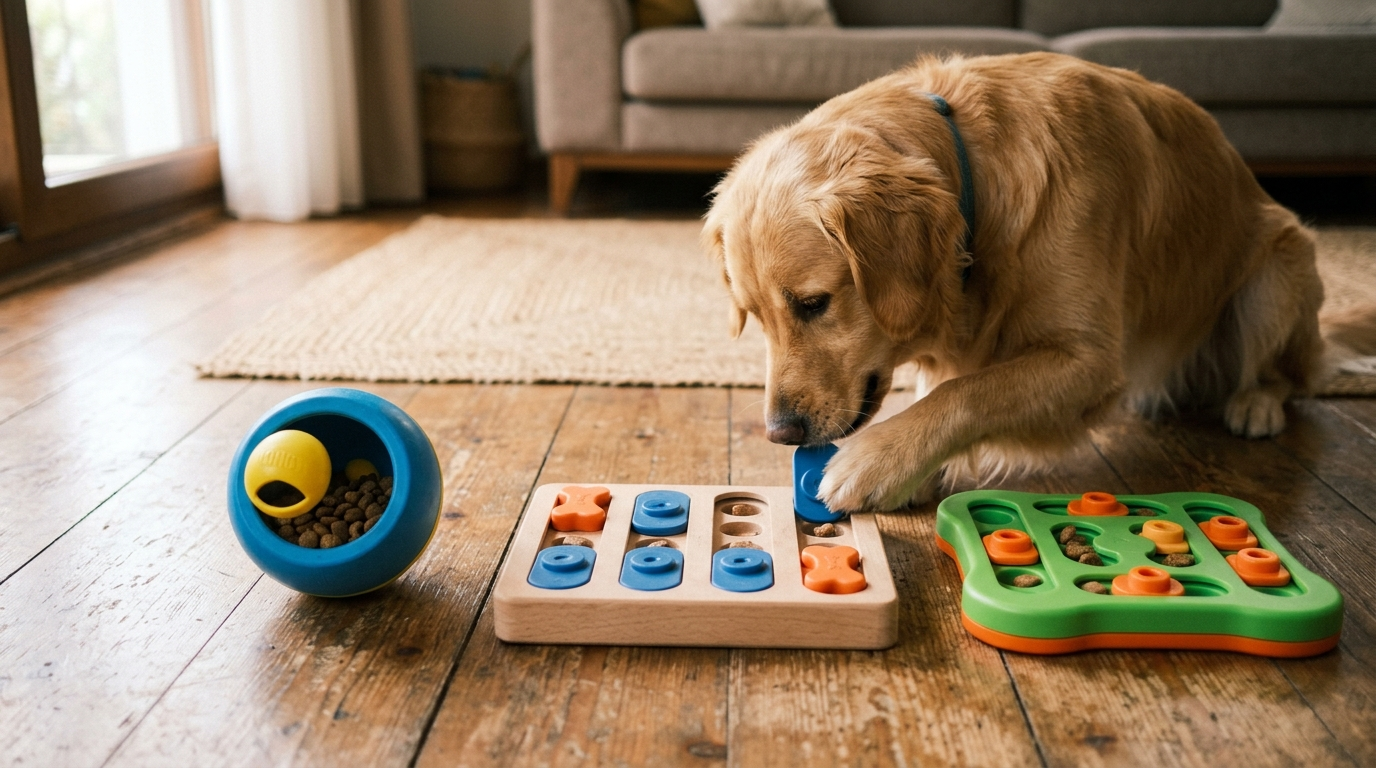
Difficulty usually comes from the number of actions required, how visible the reward is, and how much physical manipulation the toy demands. A beginner toy might expose treats when a dog pushes a panel. A more advanced design may require the dog to move one piece before reaching another compartment.
For a new player, select a toy with large, visible openings and one clear action. Place part of the daily meal inside rather than adding many extra treats. Once your dog consistently solves that design, introduce a second action, such as lifting a flap after moving a slider.
Do not judge difficulty only by the manufacturer’s level label. Dogs have different strengths. A toy that requires paw control may be easy for a dog that likes manipulating objects but difficult for a dog that mainly uses its nose. Watch how your dog approaches the challenge and choose the next step accordingly.
Match the toy to your dog’s play style
The most effective puzzle toy for dogs fits the way the individual dog naturally explores. Observe your dog during normal play before buying a more complicated design.
- Nose-led dogs: Try scent-based searching games, treat mats, or containers that allow easy sniffing.
- Paw users: Look for sturdy sliders, push panels, or pieces that move with controlled pressure.
- Persistent chewers: Choose thick, durable materials and avoid parts that can be bitten off.
- Gentle problem-solvers: Soft treat dispensers or fabric activities may work if they are used under supervision.
- Fast eaters: A food puzzle can slow access to part of a meal, but it should not replace veterinary advice for eating problems.
A dog that enjoys carrying and shaking objects may not enjoy a delicate sliding board. A dog that becomes excited by movement may need a quieter toy that rewards calm investigation. Matching the action to the dog’s preferences makes learning easier and reduces destructive attempts.
Choose safe and suitable materials
Material selection should reflect your dog’s bite strength and habits. Food-grade plastic, solid rubber, and well-constructed wood can all be suitable when the product is designed for dogs and remains intact. The important question is whether your dog can damage the toy during normal use.
Avoid designs with loose pieces that can be swallowed, sharp edges, toxic coatings, or openings that could trap a jaw or paw. Fabric toys may be unsuitable for dogs that tear and ingest material. Check the toy before every use, especially after your dog has discovered how to grip its edges.
Size also matters. The toy should be large enough that your dog cannot swallow it or place the entire object in its mouth. Treat openings should release appropriately sized food without forcing the dog to bite or lick in an awkward position.
Plan supervision and reward placement
Every new puzzle toy for dogs should be introduced while an adult is watching. Supervision lets you identify unsafe chewing, guarding, frustration, or attempts to break the toy. It also helps you learn whether the challenge is too easy or too difficult.
Use small portions of your dog’s normal food when possible, and account for those calories in the daily meal. Begin by leaving some rewards partly visible. After your dog learns the required action, make the reward less obvious or use fewer compartments. This gradual progression keeps the activity understandable.
End the session while your dog is still interested. Short sessions are usually more productive than leaving the toy available until the dog becomes tired or frustrated. When the toy is used as a calm enrichment activity, offer it in a quiet area away from other pets that might create competition.
Signs the challenge needs adjustment
Your dog’s behavior provides useful feedback. Repeatedly walking away, pawing aggressively, whining, or trying to chew through the toy suggests that the setup may be too difficult or poorly matched to the dog’s play style. Reduce the challenge by exposing more food, using a simpler compartment, or demonstrating the action.
If your dog empties the toy immediately and loses interest, increase difficulty one step at a time. You might use smaller food pieces, cover more openings, or introduce a second action. Avoid making several changes at once because you will not know which change affected the experience.
Even an advanced puzzle toy for dogs should not be treated as a test of intelligence. The goal is safe enrichment, not forcing a dog to work until it becomes distressed. Some dogs prefer rotating between several simple activities instead of mastering one complex design.
A practical buying checklist
Before purchasing, confirm that the toy matches your dog in five areas:
- The starting difficulty offers an achievable first reward.
- The material can withstand your dog’s chewing and handling style.
- The size prevents swallowing and does not create trapping hazards.
- The toy can be cleaned thoroughly after food use.
- You can supervise the first sessions and inspect the toy regularly.
The right choice may be a simple design used creatively rather than the most complicated product available. Select a challenge your dog can understand, then adjust the reward placement as the skill develops. A well-matched puzzle supports focused play, mental enrichment, and a safer daily routine.