Finding a chew toy for aggressive chewers requires more than choosing the hardest product on the shelf. Dogs that quickly destroy ordinary toys need an option matched to their chewing style, jaw strength, size, and supervision needs. No toy is truly indestructible, but the right design can reduce breakage and make play safer.
What makes a chew toy suitable for aggressive chewers?
A good chew toy for aggressive chewers should be durable without becoming dangerously hard. It also needs to have a shape that is difficult to tear apart and a size that your dog cannot swallow or fit fully behind the back teeth.
Look for toys made for determined chewers rather than general-purpose plush or thin rubber toys. Product descriptions can help, but your dog’s past behavior is more useful than a durability label. A dog that removes stuffing in minutes needs a different toy from one that only leaves light tooth marks.
Compare the most useful toy materials
- Natural rubber: Thick, flexible rubber is often a practical choice for dogs that enjoy firm chewing. It should bend slightly rather than feel rock-hard.
- Dense nylon: Nylon toys can last a long time, but they may become rough or develop sharp edges as the dog chews them. They require frequent inspection.
- Rope: Braided rope can provide texture and interactive play. It is less suitable for unsupervised chewing if your dog pulls off and swallows strands.
- Hard plastic: Rigid plastic may crack into sharp pieces. Use extra caution with thin or brittle designs.
- Plush fabric: Plush toys are usually better for gentle play than sustained chewing. They should not be treated as a durable option for a dog that routinely removes seams or stuffing.
Material alone does not determine safety. A thick rubber toy with a hollow center may be more useful than a solid, extremely hard toy that puts excessive pressure on the teeth.
Choose the shape according to your dog’s play style
The best chew toy for aggressive chewers should suit the way your dog uses its mouth. Some dogs clamp down and chew in one place, while others carry, toss, paw, and pull their toys apart.
- Rounded toys: These are easy to carry and generally have fewer corners for a dog to attack.
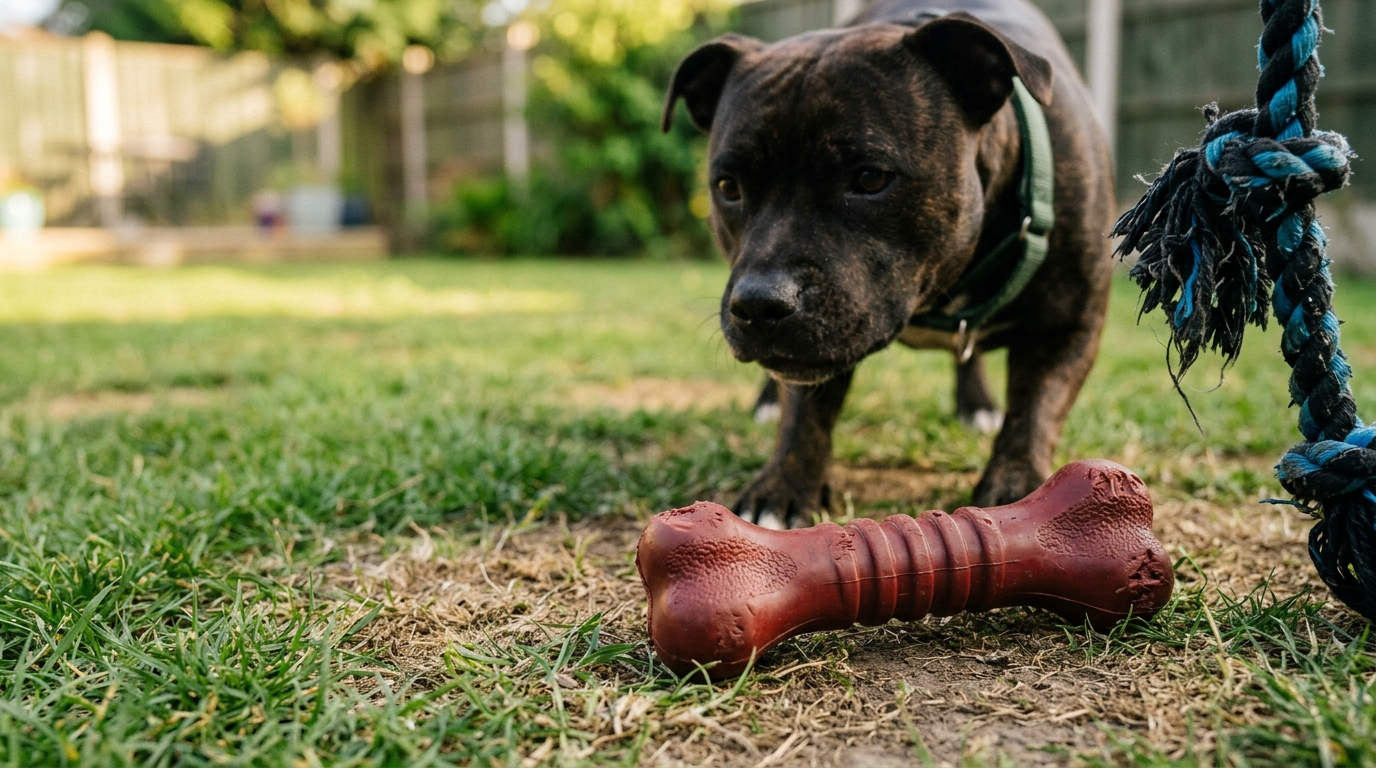
- Ridged toys: Grooves can add texture and may hold a small amount of food, making the toy more engaging.
- Ring-shaped toys: Rings work well for dogs that like tugging, but they must be thick enough to resist bending or tearing.
- Irregular shapes: Uneven designs can make a toy harder to grip and may provide more varied play.
A toy that keeps your dog interested may receive less concentrated chewing than a plain object. Food-stuffable designs can be useful for redirecting chewing toward an appropriate item, provided the opening is large enough to clean properly.
Check size, flexibility, and construction
Size is one of the most important safety decisions. The chew toy for aggressive chewers should be large enough that your dog cannot swallow it and should not be so small that it can become lodged in the mouth. Follow the manufacturer’s size guidance, then adjust for your individual dog’s bite and habits.
Press or bend the toy before buying when possible. A little flexibility is preferable to a material that feels like a stone. Avoid toys with thin fins, loosely attached parts, narrow handles, or decorative pieces that can be pulled away.
Do not assume that a bigger dog always needs the hardest available toy. A strong chewer can still fracture a tooth on an excessively rigid product. Durability should mean resistance to tearing and breaking, not maximum hardness.
Use supervision as part of the safety plan
Even the most durable chew toy for aggressive chewers can fail. Introduce a new toy while you are present and watch how your dog interacts with it. Remove the toy immediately if you see cracks, sharp edges, missing pieces, loose threads, or a change in shape.
Supervision is especially important during tug games. Do not allow your dog to bite down on a damaged rope, and stop play if the toy becomes small enough to swallow. Keep several suitable toys available and rotate them so one item does not receive constant heavy use.
Know when to replace the toy
Inspect a chew toy for aggressive chewers before and after play. Deep punctures, exposed layers, chunks missing from the surface, sharp ridges, and permanent deformation are clear replacement signals. Cleaning instructions also matter because some toys can trap food or saliva in areas that are difficult to reach.
If your dog swallows part of a toy, contact a veterinarian promptly for advice, especially if vomiting, gagging, abdominal pain, weakness, or loss of appetite appears. Do not wait for a serious symptom if you know a large piece was swallowed.
A practical buying decision
The safest chew toy for aggressive chewers combines an appropriate size, resilient but not rock-hard material, a simple construction, and a shape your dog will actually use. Start with one well-made option, supervise the first sessions, and judge its performance by wear rather than marketing claims. A toy that remains intact, is easy to clean, and keeps your dog engaged is usually a better choice than the hardest product available.
You can check our other articles about toys: dog toys
Also you can check best-seller chew toy for you dog here : https://amzn.to/4dQjhj